How to Choose the Best Online Quran Classes for Kids (Parent's Complete Guide 2026)
Every parent dreams of giving their child the best education. We carefully choose the best schools, the best teachers, and the safest environments to help them succeed in life. But have you ever wondered if you're giving the same level of attention to your child's Quran education?
Learning the Holy Quran is not just another subject — it is a lifelong journey that shapes a child's faith, character, and connection with Allah ﷺ. Unfortunately, many parents enroll their children in the first Online Quran Academy they find without checking whether the teachers are qualified, whether the classes are interactive, or whether the learning environment truly suits children. The result is often the same: some children lose interest, some struggle with incorrect pronunciation, and many parents only realize months later that progress isn't what they hoped for.
The good news is that choosing the right Online Quran Classes doesn't have to be difficult. With the right guidance, you can find an academy that not only teaches your child to read the Quran correctly, but helps them build love, confidence, and consistency in their Islamic journey. This guide covers exactly what to check before enrolling, the mistakes to avoid, and how to decide with confidence — whether your child is just starting Noorani Qaida or is ready for Tajweed or Hifz.
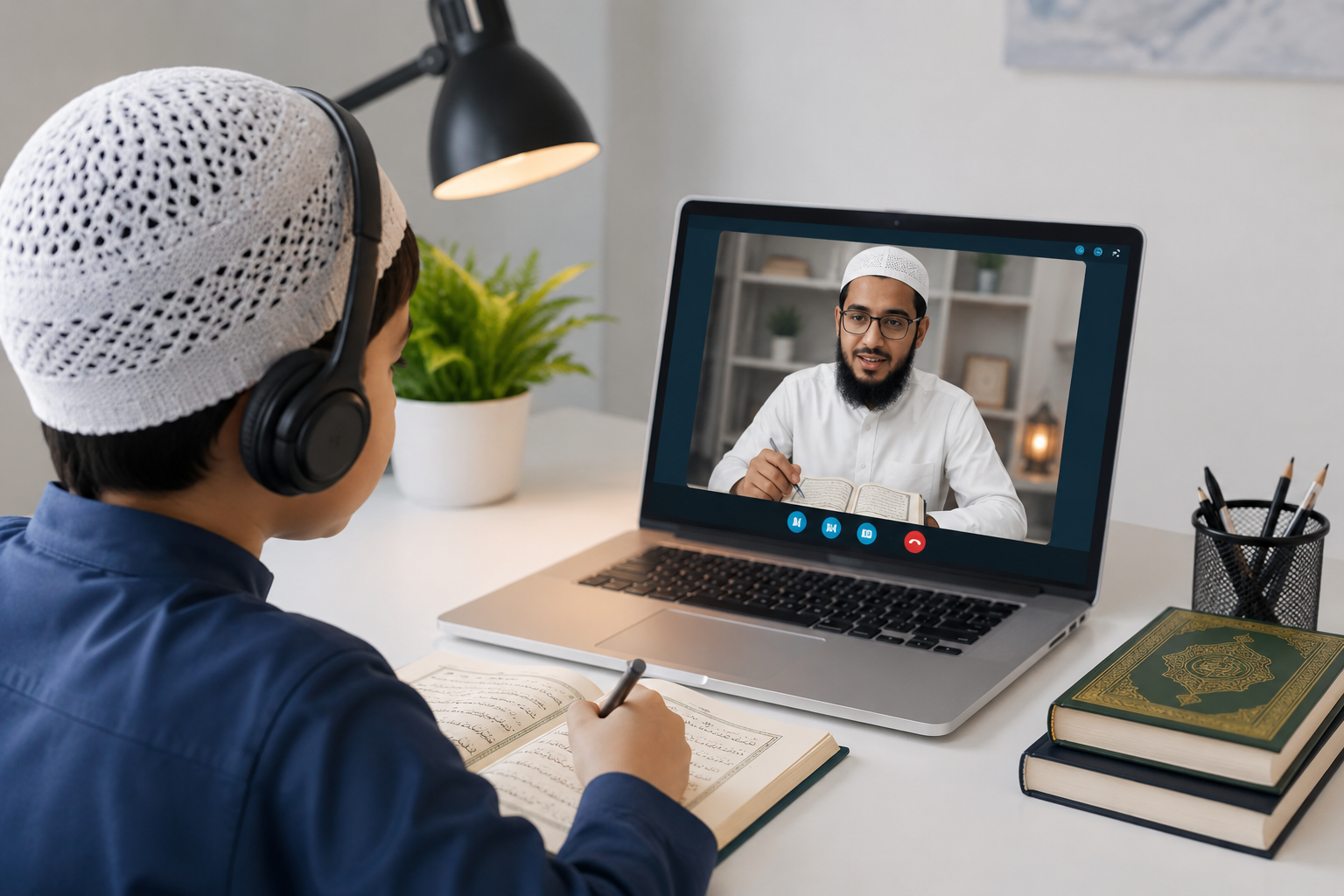
Table of Contents
Why Online Quran Learning Is Growing Faster Than Ever
A few years ago, most Muslim families preferred sending their children to a local mosque or madrasah. Today, families are busier than ever — children spend long hours at school, parents have demanding work schedules, and many Muslim families live in countries where finding a qualified Quran teacher nearby isn't easy. This is one of the biggest reasons Online Quran Classes for Kids have become increasingly popular around the world. Whether a family lives in the UK, the USA, Canada, Australia, or Europe, parents can now connect their children with experienced Quran teachers without leaving home.
When taught correctly, online classes offer real advantages: personalized one-to-one attention, flexible class timings, qualified male and female teachers, comfortable learning from home, better communication between parents and teachers, and consistent progress without long travel times. Children also tend to feel more confident learning in a familiar environment where they can ask questions freely and build a positive relationship with their teacher.
Who Should Read This Guide?
This guide is written for parents who want to make the best decision for their children's Quran education — especially if you're looking for the best Online Quran Classes for Kids, living in the UK, USA, Canada, Australia, or Europe, searching for qualified male or female teachers, or wanting one-to-one lessons instead of crowded group classes with flexible timings that fit around school. It's equally useful if your child has already started learning and you want to evaluate whether your current academy is truly delivering the quality of education they deserve.
- How to identify a trustworthy Online Quran Academy
- What questions every parent should ask before enrolling
- The biggest mistakes parents make
- The features that actually improve a child's learning
- How to choose an academy with confidence
10 Things Every Parent Must Check Before Choosing an Online Quran Academy
Choosing an Online Quran Academy isn't just about finding someone who can teach the Quran — it's about choosing someone who will become part of your child's Islamic journey. A child may spend hundreds of hours with their Quran teacher over the coming months or years, and that teacher will shape not only how your child reads the Quran, but how they feel about Islam, learning, discipline, and worship. Before enrolling your child, make sure the academy meets the following standards.
1. Qualified & Certified Quran Teachers Matter More Than You Think
Most parents would never accept a school teacher with no qualifications, yet many enroll their children in an Online Quran Academy without asking a single question about the teacher's background. A qualified Quran teacher doesn't simply know how to read the Quran — they understand Tajweed rules, know how to correct pronunciation gently, understand how children learn, and teach with patience. A child who is constantly corrected harshly may begin to fear class; a patient teacher builds confidence one lesson at a time. Before enrolling, ask whether the teacher is qualified, whether they've studied Quran with Tajweed, whether they have experience teaching children, and whether you can meet them during a trial class. A professional academy will always be happy to answer.
2. One-to-One Classes vs Group Classes — Which Is Better?
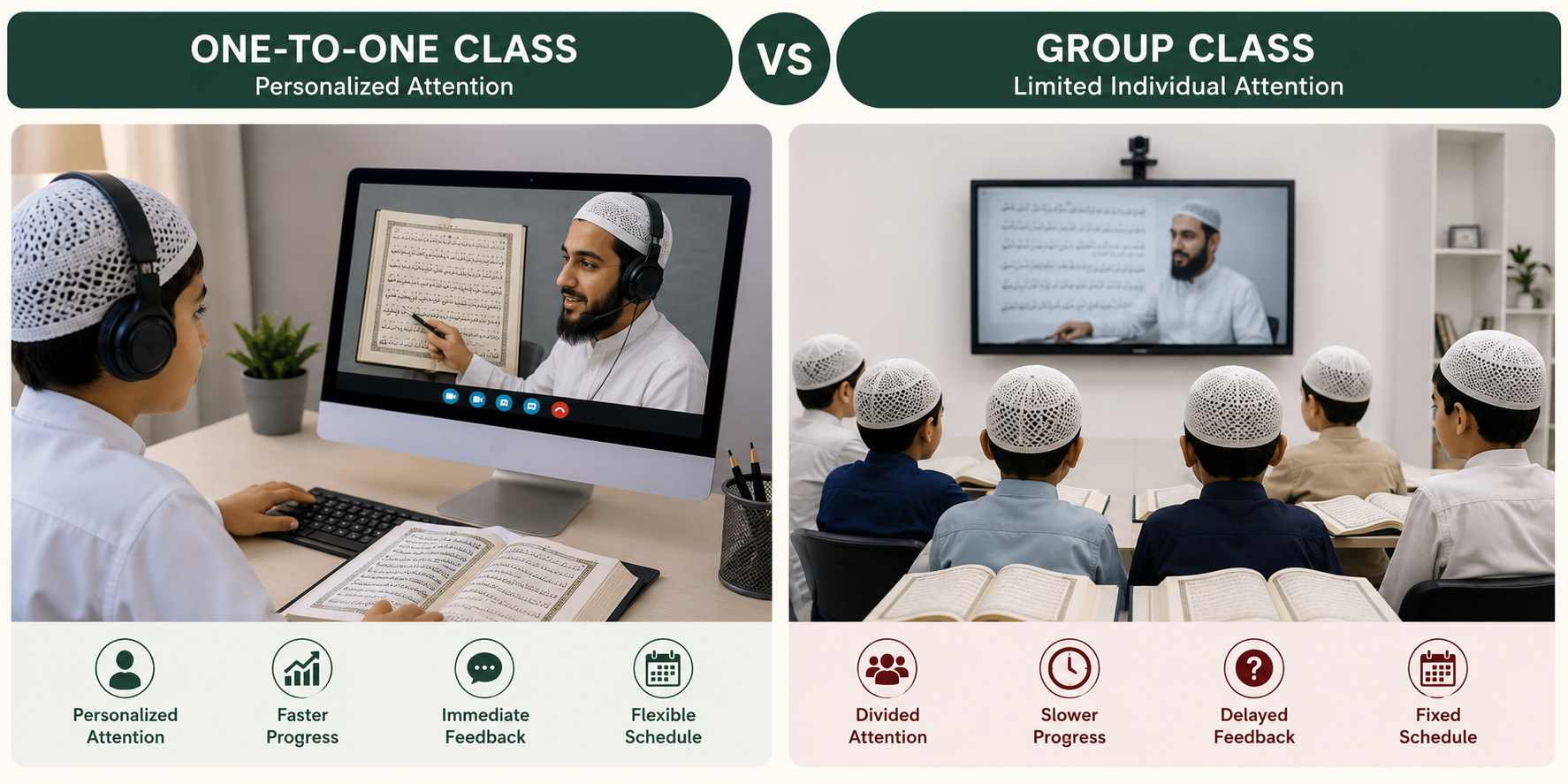
Many parents assume group classes are enough, since schools and mosques often teach in groups. But learning the Quran is deeply personal — every child learns at a different pace, and in a group class it's almost impossible for one teacher to give every child equal attention. In a one-to-one session, every minute belongs to your child: every pronunciation mistake is corrected immediately, every question is answered, and every lesson moves at your child's own speed. One-to-one classes offer individual attention, faster learning, better pronunciation correction, higher confidence, a stronger teacher-student relationship, and personalized lesson plans — a real difference for younger children especially.
3. Flexible Timings Make Learning Easier for the Whole Family
Modern family life is busy — school, homework, exams, sports, and family commitments all compete for a child's time. Fixed Quran class schedules that don't fit tend to make children tired, parents stressed, and classes missed, which eventually makes learning inconsistent. A good academy offers flexible scheduling built around your family's routine, so children learn when they're mentally fresh, attendance improves, and consistency improves. Remember: it's far better for your child to attend three focused classes every week consistently than to attend daily classes irregularly. Learning the Quran is a lifelong journey, not a race.
4. A Safe & Child-Friendly Learning Environment Is Non-Negotiable
Before enrolling your child, ask which platform is used for classes, whether parents can join or observe a lesson if needed, whether communication methods are professional and transparent, and whether the academy has clear policies for student safety and privacy. A trustworthy academy welcomes these questions. Safety isn't only about technology — it's about a respectful, encouraging, age-appropriate environment where children feel comfortable asking questions, making mistakes, and growing in confidence. A child who feels safe is far more likely to enjoy learning and stay committed long-term.
- Is the teacher qualified and experienced?
- Will my child get personal attention?
- Do the class timings fit our family's routine?
- Is the learning environment safe and child-friendly?
5. Never Skip the Free Trial Class
A beautiful website doesn't guarantee a great teacher, and a professional logo doesn't guarantee quality teaching. That's exactly why a Free Trial Class is one of the most important things every parent should look for — it lets you and your child experience the teacher before making any commitment. During the trial, don't focus only on whether your child can read correctly; watch how the teacher interacts with them. Does the teacher smile, encourage questions, and correct mistakes with kindness? Does your child look comfortable? Often, within just 20–30 minutes, parents can tell whether a teacher is the right fit.
6. A Good Academy Doesn't Just Teach — It Shows Progress
After several months, parents often start wondering whether their child is actually improving, learning Tajweed correctly, or what to practice at home. A professional academy never leaves parents guessing — it regularly shares progress updates covering reading improvement, Tajweed correction, lesson completion, homework performance, memorization progress, attendance, and areas needing extra practice. These reports build teamwork between parents and teachers, and children perform better when they know both are working together.
7. The Best Quran Academies Follow a Clear Learning Roadmap
A well-organized academy follows a step-by-step learning journey rather than starting wherever seems convenient. Typically this looks like: Stage 1 — Noorani Qaida, where children learn Arabic letters, pronunciation, and basic reading; Stage 2 — Basic Tajweed Rules, understanding correct pronunciation and recitation; Stage 3 — Fluent Quran Reading, building fluency, confidence, and accuracy; Stage 4 — Memorization (optional), where students begin Hifz under proper guidance; and Stage 5 — Islamic Studies, covering daily Duas, Islamic manners, and essential knowledge. This structured approach keeps children motivated because every lesson brings them one step closer to a clear goal.
8. Parents Should Never Feel Left Out
Your child's Quran education should never feel like a mystery. As a parent, you deserve to know what your child learned today, which Surahs they completed, where they need more practice, and whether they're improving. Some academies communicate only when it's time to collect fees — that isn't quality education. The best academies build a real partnership with parents: they encourage feedback, answer questions, listen to concerns, and celebrate your child's achievements with you, because Quran education is a journey shared by the teacher, the parents, and the child together.
Before enrolling your child anywhere, ask yourself one simple question: "Am I choosing an academy because it is the cheapest, or because it will genuinely help my child build a lifelong relationship with the Quran?"
7 Red Flags Every Parent Should Never Ignore
Choosing the wrong academy doesn't always show its effects immediately — everything can seem fine for the first few weeks before parents realize progress is much slower than expected. These problems usually begin with small warning signs that are easy to miss. If you notice any of the following, take a step back before making a long-term commitment.
Online Quran Classes vs Local Mosque Classes
Many parents ask whether they should choose Online Quran Classes or continue with their local mosque. The honest answer is that both have their own strengths, and the right choice depends on your family's needs, your child's personality, and the quality of teaching available.
| Online Quran Classes | Local Mosque Classes |
|---|---|
| Learn from home without travelling | Travel required |
| One-to-one attention available | Usually group classes |
| Flexible timings | Fixed schedules |
| Parents can monitor progress more easily | Parent involvement may be limited |
| Suitable for families living abroad | Depends on local availability |
| Personalized learning pace | One pace for the whole class |
This doesn't mean local mosque classes are bad — many mosques provide excellent Islamic education and a strong sense of community. But for families with busy schedules, or those living where qualified teachers are hard to find, Online Quran Classes can offer the flexibility, consistency, and personalized learning that suits them better. The most important factor isn't whether the class is online or offline — it's the quality of teaching and its impact on your child.
Years from now, your child probably won't remember how much you paid for their Quran classes, but they will remember how those classes made them feel. If they learn with love, patience, encouragement, and sincerity, the Quran becomes more than a book they can read — it becomes a companion they carry in their hearts for life.
Frequently Asked Questions
What is the best age for a child to start learning the Quran?
There isn't one perfect age that suits every child, but many Islamic educators recommend introducing the Quran between 4 and 6 years old, depending on maturity and ability to focus. Starting with the right teacher matters more than starting early.
Are Online Quran Classes really effective?
Yes, when taught by qualified teachers in a structured environment. They offer one-to-one learning, flexible timings, individual attention, and consistent progress from home. The teacher's quality matters far more than whether the class is online or offline.
How many Quran classes should my child take every week?
Most children make excellent progress with 3 to 5 classes per week. Consistency matters more than quantity — regular weekly attendance beats short intensive bursts followed by long gaps.
Should I choose a male or female Quran teacher?
Both can be excellent. What matters most is qualification, experience, patience, teaching style, and how comfortable your child feels — many parents prefer female teachers for young girls, while others simply choose whoever their child connects with best.
Can beginners join Online Quran Classes?
Absolutely. Most children begin with Noorani Qaida, learning Arabic letters and basic pronunciation, before moving on to Quran recitation with Tajweed. Every experienced academy is equipped to start complete beginners.
How long does it take to learn Quran with Tajweed?
Every child learns at a different pace depending on age, consistency, home practice, and class frequency. Rather than comparing your child to others, focus on steady, patient improvement.
How can parents support their child's Quran learning?
Simple things like encouraging your child, celebrating small achievements, creating a quiet study space, asking about today's lesson, and listening to their recitation can significantly increase motivation and confidence.
What should I ask before enrolling in an Online Quran Academy?
Ask whether teachers are qualified, if one-to-one classes are offered, whether a free trial exists, how progress reports are shared, whether missed classes are recorded, how progress is assessed, and if both male and female teachers are available.
Final Parent Checklist
- Qualified & experienced Quran teachers
- One-to-one interactive classes
- Flexible class timings
- Safe online learning environment
- Free Trial Class available
- Monthly progress reports
- Structured curriculum
- Ongoing parent communication
- Positive student reviews
- A teaching style that inspires love for the Quran
If you can confidently tick all of these boxes, you're already much closer to making the right decision for your child's Islamic education. At Ilm e Deen Institute, our mission is simple: to help children and adults around the world learn the Holy Quran with correct Tajweed, qualified teachers, and a supportive learning environment — offering one-to-one classes, qualified male & female teachers, Noorani Qaida, Quran Reading with Tajweed, Hifz-ul-Quran, and Islamic Studies, with flexible timings and worldwide availability.